

Building Belonging for GMP in STEM

MY ROLE:
UX Research, Marketing, Event Host
TOOLS:
Mural and Figma
TIMELINE:
9 Months
TEAM:
Team of 6
Our team researched the inequities that women in STEM experience. We further expanded our topic to include any gender identity that faced similar experiences and hardships. From our research, we found that GMP in STEM often combat feelings of inadequacy and isolation within their environment.
Context
What does the term Gender-Marginalized mean?
A gender-marginalized person (GMP) is someone who could identify as a transgender woman, cisgender woman, transgender man, non-binary individual, or any gender identity that has been systematically oppressed by those in power throughout history, especially in the political realm.
The Problem
Gender-marginalized people experience varying hardships within the STEM community. Some examples of this can be receiving limited or no support, mistreatment, and judgment. In addition, there is also a lack of visible representation of those who identify as a Gender-Marginalized person in STEM.
Our goal was to address the lack of support and misrepresentation of gender-marginalized students' experiences on campus. We wanted to research first-hand what this group of students experience and include them in finding a desirable solution.
How might we build better community support for gender-marginalized students in STEM at UCSD in order to combat feelings of inadequacy and isolation?
Research
Meta-Analysis of Secondary Research
Our team delved into reviewing research studies and statistics within our problem space of GMP in STEM. We found that:
Negative stereotypes around women's performance in math during their pre-college years can undermine their interest and performance in STEM fields. (Alfred & Johnson)
By the time students reach college, women are significantly underrepresented in STEM majors — for instance, only 21% of engineering majors are women and only around 19% of computer and information science majors are women. (AAUW)
Women are nearly half the U.S. workforce but only 27% of them are STEM workers. Men make up 52% of workers in the U.S. but 73% of all STEM workers. (US Census)
Women of Color earn the smallest share of STEM degrees 14.1%. (via Catalyst)
From our preliminary research, our team decided to broaden our scope beyond researching women in STEM and also to include any gender identity who share similar experiences within the STEM community. This is where our use of the term "gender-marginalized people" was adapted to our community project.
Primary Research
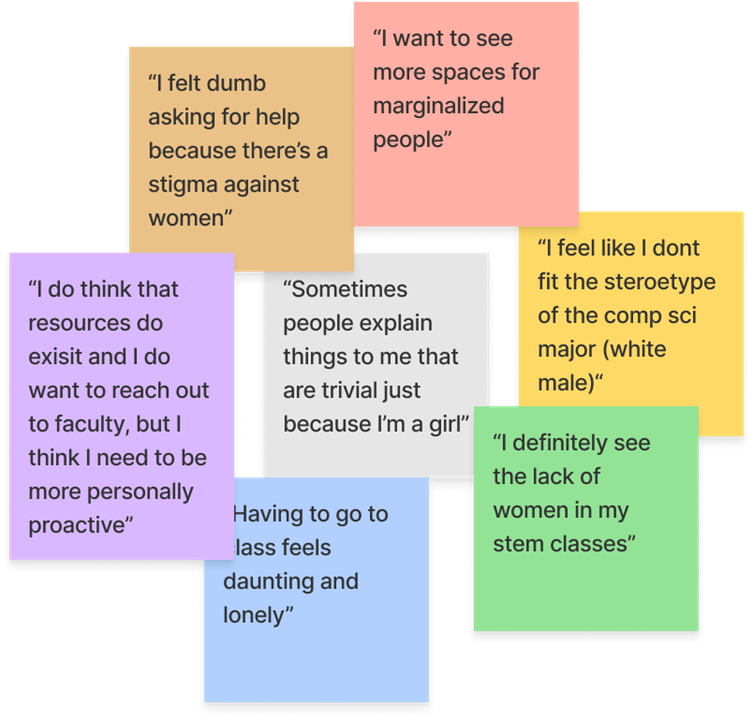
In addition to our preliminary research, we conducted a centralized study at UCSD, sent out surveys and conducted 11 in-depth user interviews within the UCSD community. We found that most students who are GMP in STEM felt that they were not getting the support they needed to be successful. Highlighted are a few responses below:
Key Insights
Recurring themes from our interviewee responses echoed feelings of isolation and alienation, imposter syndrome, having to put in extra effort for their voices to be heard, and personally seeing that lack of diversity within the classrooms, especially in upper division courses where these feelings were further amplified. With this in mind my team decided to focus on the following to incorporate when ideating potential solutions:

Visibility of Resources
Resources and student opportunities need to be more visible and accessible for everyone

Faculty Support
Students would like more opportunities to connect with faculty

Mentorship
Mentorship programs should be easily available and centralized in one place

Explicit Welcome
Students want spaces to be more proactive in making them feel more comfortable and included
Ideation
Community Partner

Access to student resources
Mentorship Opportunities
Support students' academic
success
Mentorship For All mission to support students' success at UCSD aligned with our own goals. From their collaboration, we were able to find a space and use to host our event for GMP in STEM.
After conducting our research, our team better understood the potential solutions we could ideate. We looked into continuing community involvement within our process and sought a community partner.
Our goal was to find an organization to support our team in realizing a viable solution. In our search we came across the organization, Mentorship For All @UCSD led by Lovella Cacho, Outreach Manager for Qualcomm Institute.
Community Stakeholders
In addition to communicating with our community partner, our team also spoke with other organizations on campus that represent and work with diverse groups of students, who would potentially identify as GMP in STEM.

The Raza Resource Center is open to everyone and strives to emphasize and foster the access, retention, and graduation of Chicanx-Latinx students as well as create strong connections with our surrounding community.

The LGBT Resource Center is open to all and encourages students to connect with other LGBTQIA+ students, participate in organizations and programs, and learn about social justice, equity, and inclusion.

The CSE Diversity, Equity, and Inclusion department embraces different perspectives, backgrounds, and experiences to better train tomorrow's student leaders.

OASIS facilitates to create a holistic enrichment of UCSD students through community-based, and culturally responsive mentoring, academic support, and professional development.

The Women’s Center provides education and support to all members of UCSD regarding gender issues, with the goal of promoting an inclusive and equitable campus community.

Sixth College Residential Life inspires students to achieve their highest personal potential by providing collaborative residential programs & services that encourage community, wellness, inclusion, and learning.
Their feedback on our potential solutions, their advice to continue advocating and including GMP in STEM at every stage, and suggestions for creating a prototype allowed our team to hone in on our final solution for GMP in STEM. Listed below is what our team strived to create for GMP in STEM.
Community Feedback
Study space specific to GMP in STEM
Community space for faculty, staff, and students
Gender-Marginalized students, faculty, and alumni network
Solution(s)
Resource Guide
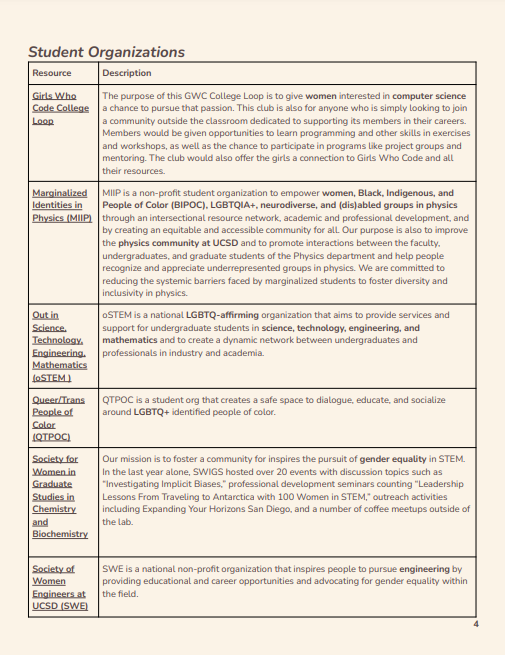
Curated to incease visiblity of active on campus resources such as student orgs, resource centers, inclusive housing and scholarships.
In Person Community Event
Hosted an open forum in collaboration with community orgs to highlight resources available and give opportunity for students to foster connections.
Logistics
From the many, many zoom meetings and emails we were able to have the opportunity to host an event for GMP in STEM. Along with the support of Lovella Cacho, Mentoring for All @UCSD, we were able to successfully pilot our event as having an inclusive space.

Marketing
My role in creating marketing materials for our event was to design the final event poster. I created a few different poster designs and elements.
In creating varying iterations of my poster designs, I wanted to keep the design simple, have a clear hierarchy, and wanted to play around with the layout.


Final Event Poster
In the final iteration of our event poster, I used a few different elements from my previous iterations to create this final piece. The content of what was needed in this poster was changed and simplified to what was only strictly necessary to promote it.


Resource Guide
Our resource guide created in google docs, has curated resources for GMP in STEM to build community and support to be successful @UCSD. In addition, our cover was designed to highlight a few incredible individuals who became successful in STEM.

Our Event
Sign In & Welcome
5:00 PM - 5: 15 PM
Team Presentation
5:15 PM - 5: 45 PM
.jpg)

Sticky notes from open discussion
Ice Breakers & Open Discussion Forum
5:45 PM - 6:10 PM
-
What is one piece of advice you would give to your 13 year old self?
-
What changes would you like to see for GMP in STEM at UCSD?
Our responses to our questions voiced a lot of support for continuing the conversation of GMP in STEM.

Student Org Tabling & End of Night Raffle
6:10 PM - 7:00 PM
In addition to our open forum and resource guide, we had a few organizations table at our event to share their resources.
We are very grateful for Raza Resource Center, Women's Center, OASIS, and LGBT Resource Center in being able to attend.




Reflection
Unlike my previous projects, this experience broadened my perspective beyond traditional web and app design. I found it immensely rewarding to navigate a more comprehensive design process, which deepened my appreciation for collaborative and community design. This case study highlights the importance of community engagement in achieving meaningful outcomes. Personally, this case study resonated with me as a woman in STEM who shared similar experiences and found the working on such a topic not only validating but gratifying as well.
Skills Improved
Soft Skills
-
Empathy
-
Teamwork
-
Collaboration
Next Steps
For this case study, the next steps would be to conduct more targeted user interviews and continue open discussions with community stakeholders to confirm continued interest. Then I would organize in collaboration with community partner and stakeholders to hold another open discussion forum to continue this conversation. In addition, I would send out post surveys, to gain attendee feedback. Next after gathering my data, I would present it to the student association and univesity to advocate for a physical space for the community.
Technical Skills
-
User Research
-
Community Stakeholder Expectations
-
Codesign